Unlock Email Data Insights with AI: Boost Productivity
Is your inbox a black hole, consuming your time and energy without yielding clear benefits? For many professionals, entrepreneurs, and teams, email is a constant deluge, a source of both critical communication and overwhelming noise. We spend hours each day sifting, sorting, and responding, often feeling like we're treading water rather than making progress. But what if this seemingly chaotic stream of messages held the key to unlocking unprecedented levels of productivity and strategic advantage? This is where the power of email data insights comes into play.
In today's fast-paced digital landscape, the ability to extract meaningful intelligence from your email communications is no longer a luxury; it's a necessity. Every email you send and receive contains valuable information about your clients, colleagues, projects, and market trends. However, manually analyzing this vast volume of data is practically impossible. Fortunately, advancements in artificial intelligence (AI) are revolutionizing how we interact with our inboxes, transforming them from simple communication tools into powerful engines of business intelligence. By leveraging AI-powered solutions, you can move beyond reactive email management and embrace a proactive, data-driven approach to boost efficiency, enhance communication, and drive significant business growth.
What Are Email Data Insights and Why Do They Matter?
At its core, email data insights refer to the actionable intelligence derived from analyzing the content, patterns, and metadata of your email communications. This isn't just about counting the number of emails you send or receive; it's about understanding the 'who, what, when, and why' behind those interactions.
Think about the sheer volume of information flowing through your inbox daily:
- Customer inquiries and feedback
- Sales leads and negotiation details
- Project updates and team collaboration
- Internal communications and strategic discussions
- Market trends and competitor mentions
When analyzed effectively, this data can reveal critical business intelligence that impacts every facet of your operation. Why do these insights matter so much?
- Enhanced Business Intelligence: Understand customer sentiment, identify emerging market needs, and gauge the health of your business relationships.
- Improved Communication Effectiveness: Learn preferred communication styles, identify bottlenecks, and tailor your messages for maximum impact.
- Boosted Productivity: Automate repetitive tasks, prioritize effectively, and reduce time spent on managing email overload.
- Data-Driven Decision Making: Base strategic choices on real communication patterns rather than assumptions.
- Deeper Stakeholder Understanding: Gain insights into client satisfaction, employee engagement, and partner dynamics.
Without a systematic way to process this information, these valuable insights remain hidden, leading to missed opportunities, inefficient workflows, and a constant feeling of being overwhelmed. The ability to glean email insights transforms your inbox from a chore into a strategic asset.
How AI is Revolutionizing Email Data Analysis
The human capacity to manually sift through thousands of emails to find patterns, trends, and actionable intelligence is severely limited. This is where artificial intelligence (AI) steps in, offering a powerful solution to the modern email challenge. AI, particularly through machine learning and natural language processing (NLP), can process, analyze, and interpret vast quantities of email data at speeds and scales impossible for humans.
Here's how AI is revolutionizing email analytics and management:
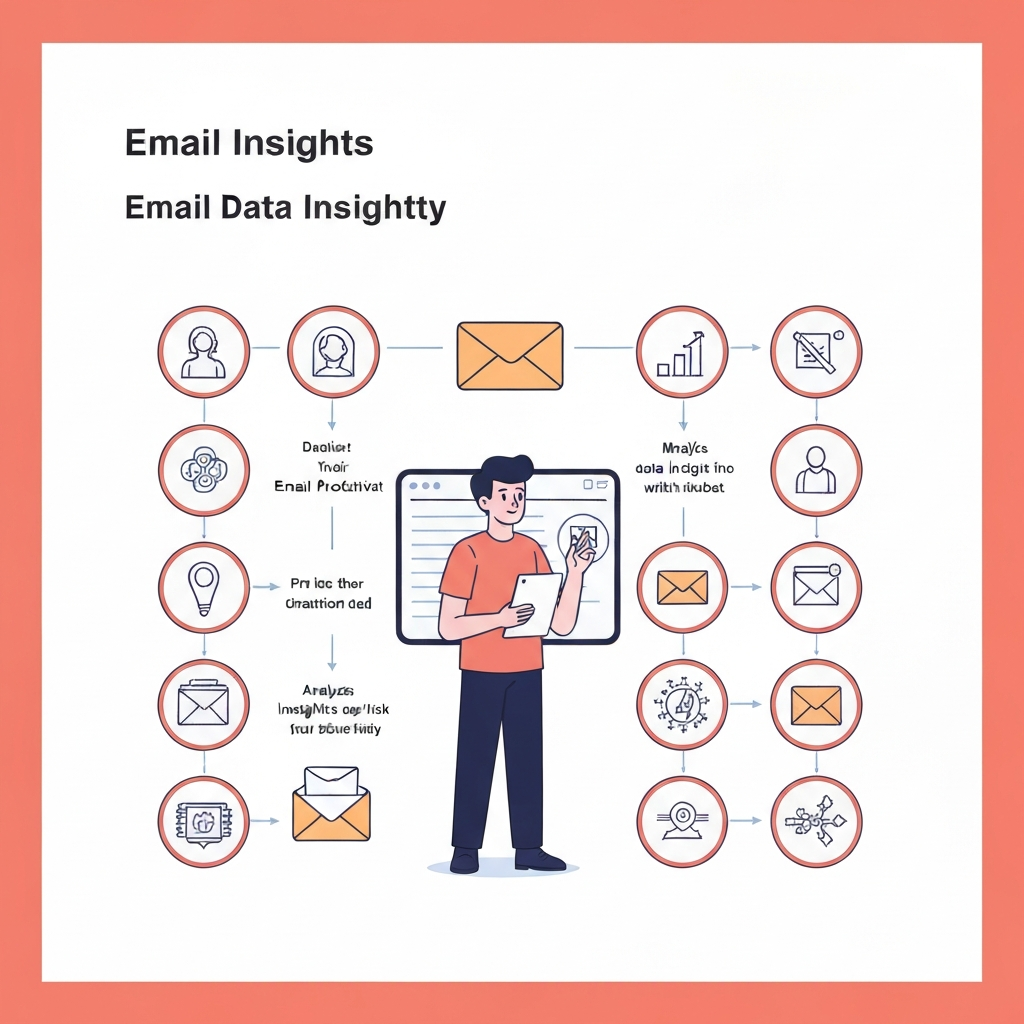
- Automated Data Extraction: AI can automatically identify and extract key information from emails, such as names, dates, contact details, project references, and sentiment.
- Pattern Recognition: Machine learning algorithms can detect recurring themes, communication frequencies, response time patterns, and sender/recipient relationships that might otherwise go unnoticed.
- Sentiment Analysis: NLP allows AI to understand the tone and emotion within emails, providing insights into customer satisfaction, employee morale, or the general sentiment around a project or product.
- Predictive Analytics: Based on historical data, AI can predict future communication needs, potential issues, or the likelihood of a deal closing, enabling proactive strategies.
- Intelligent Categorization and Prioritization: AI can automatically sort and flag emails based on urgency, sender importance, topic, or sentiment, helping users focus on what matters most.
The traditional approach to managing email has been largely reactive. We respond to what comes in, often without a clear understanding of its broader implications. AI email management shifts this paradigm entirely. It empowers businesses and individuals to move from simply processing emails to strategically leveraging them. As highlighted by Vishal Mehta on LinkedIn, "Every email you receive holds valuable information. But in today’s fast-paced digital world, manually going through hundreds of emails can be... [overwhelming]." AI solves this by making the invisible visible.
Furthermore, AI-driven tools can automate tasks like drafting replies, scheduling follow-ups, and summarizing long email threads, freeing up valuable time. This is crucial for enhancing overall productivity and fostering a more data-driven communication environment. The benefits of using AI for email management extend beyond just organization; they fundamentally transform your relationship with email, making it a more productive and less stressful part of your day.
Key Email Data Insights to Track for Business Growth
To effectively leverage your email communications, you need to know what metrics to track. Focusing on specific email insights can provide a clear roadmap for improvement and growth. Here are some of the most critical data points to monitor:
1. Response Times
How quickly are you and your team responding to emails? This is particularly crucial for sales and customer service. Long response times can lead to lost leads, frustrated customers, and damaged reputation. Analyzing average response times by sender, recipient, or department can reveal areas needing immediate attention.
Why it matters: Quick responses build trust and demonstrate efficiency. For sales teams, faster replies directly impact conversion rates. For customer support, they ensure customer satisfaction.
Actionable tip: Implement service level agreements (SLAs) for email responses and use AI tools to monitor adherence. If you're in sales, focus on improving your sales email velocity. Read more about how reply speed matters in our article, Boost Sales Email Velocity: Reply Speed Matters.
2. Communication Volume and Frequency
Understanding who is communicating with whom, and how often, can highlight key relationships, identify potential silos, and signal areas of high activity or potential overload. High volumes of communication with a specific client might indicate a complex project or a critical partnership. Conversely, very low engagement with a prospect could mean your outreach isn't landing.
Why it matters: It helps in resource allocation, identifying key stakeholders, and understanding communication bottlenecks within teams or with external partners.
3. Sender/Recipient Analysis
Which contacts or domains are most frequently interacting with your inbox? Are your most important clients or partners receiving timely attention? Analyzing sender and recipient patterns can help you prioritize your communication efforts and identify key relationships that need nurturing.
Why it matters: It allows you to identify your most valuable contacts and ensure they are receiving the attention they deserve, while also spotting potential risks if key relationships are underserved.
4. Topic and Keyword Trends
What are the recurring themes, questions, or issues appearing in your emails? AI can analyze the content of emails to identify common keywords, phrases, and topics. This can reveal customer pain points, popular feature requests, emerging market trends, or recurring internal challenges.
Why it matters: This insight can inform product development, marketing messaging, customer support strategies, and operational improvements.
5. Sentiment Analysis
Beyond just the words used, AI can help gauge the emotional tone of emails. Is a client expressing frustration, enthusiasm, or neutrality? Understanding the sentiment behind communications can provide early warnings of potential issues or confirm positive customer experiences.
Why it matters: Proactive intervention based on negative sentiment can prevent escalations, while positive sentiment can be leveraged for testimonials or case studies.
6. Engagement and Follow-up Rates
For sales and marketing, analyzing how recipients engage with your emails (e.g., reply rates, subsequent inquiries) is crucial. For internal communications, it can indicate the effectiveness of your messages in driving action or discussion.
Why it matters: It helps refine outreach strategies, identify effective messaging, and understand what prompts action from your audience.
By tracking and analyzing these key email data insights, businesses can gain a competitive edge, foster stronger relationships, and significantly improve operational efficiency. This is the essence of AI for business – turning everyday communication into strategic intelligence.
Practical Strategies for Using Email Insights to Boost Productivity
Understanding what your email data is telling you is only half the battle. The real magic happens when you translate these email insights into actionable strategies that enhance productivity and drive better outcomes. Here’s how you can apply this intelligence:
1. Smarter Email Prioritization and Triage
Many professionals feel overwhelmed by the sheer volume of their inbox. Email data insights, especially when powered by AI, can help you prioritize effectively. By analyzing sender importance, urgency indicators (like keywords or sentiment), and project relevance, AI can help flag critical emails and relegate less important ones. This allows you to focus your attention where it's most needed.
Actionable tip: Implement tools that offer intelligent sorting and filtering. Consider a smart inbox sorter or explore AI-powered smart email filters that learn your priorities over time.
2. Optimizing Communication Workflows
Analyzing communication patterns can reveal inefficiencies in your workflows. For instance, if a particular type of inquiry consistently leads to a long back-and-forth thread, it might indicate a need for clearer initial information, a dedicated FAQ, or a more direct communication channel. Insights into response times can highlight team members who might need additional support or training, or processes that are too slow.
Actionable tip: Map out your common communication workflows and use email data to identify bottlenecks. Streamline information sharing and response protocols based on these findings.
3. Enhancing Sales and Marketing Outreach
For sales and marketing teams, email is a primary channel. Email analytics can help personalize outreach like never before. By understanding a prospect's previous interactions, their expressed interests (via keywords in their emails), and their preferred communication style, you can craft more targeted and effective messages. Tracking engagement rates and response times helps refine campaign strategies.
Actionable tip: Use AI to segment your audience based on communication data. Personalize follow-up emails based on past conversations and identified interests. This can significantly improve open and reply rates, boosting your sales email velocity.
4. Improving Customer Service and Support
Customer feedback and inquiries arriving via email are goldmines for improving service. Sentiment analysis can alert you to dissatisfied customers before issues escalate. Identifying recurring questions or problems allows you to create better self-service resources (like FAQs or knowledge bases) or train your support team more effectively. Faster response times, as mentioned earlier, are critical for customer satisfaction.
Actionable tip: Regularly analyze customer support emails for common themes and sentiment. Use these insights to update your support documentation and train your team to address issues more efficiently.
5. Boosting Team Productivity and Collaboration
Over-communication or irrelevant communication can be a major drain on team productivity. AI can help filter out noise, summarize key discussions, and identify who needs to be involved in specific conversations. Understanding communication flows can also help managers identify team members who might be overloaded or struggling to connect with others.
Actionable tip: Encourage the use of clear subject lines and concise messaging. Leverage AI tools to summarize long threads or extract action items, reducing the time team members spend catching up. As Microsoft suggests, enlisting AI can help declutter your inbox and prioritize messages for easier management. This is a key aspect of using AI for business efficiency.
6. Strategic Decision Making
Ultimately, all these insights feed into better decision-making. If your email data consistently shows a high volume of inquiries about a specific product feature, it's a strong signal for your product development team. If client communications reveal a growing interest in a particular service, it might justify an expansion of your offerings.
Actionable tip: Regularly compile and review key email data insights with relevant stakeholders to inform strategic planning and resource allocation.
By actively seeking and applying these email data insights, you can transform your daily email interactions from a time sink into a powerful driver of productivity, efficiency, and strategic advantage. This shift towards data-driven communication is essential for any forward-thinking professional or organization.
Case Study/Examples: Businesses Benefiting from Email Data Insights
The theoretical benefits of email data insights become much clearer when we look at how real businesses are applying them. While specific proprietary data is often confidential, we can illustrate the impact with common scenarios:
Scenario 1: A Growing E-commerce Retailer
An online retailer was struggling with high customer support volume, leading to longer wait times and customer dissatisfaction. Using an AI-powered email analytics tool, they began to analyze their customer service emails.
- Insight: The analysis revealed that 30% of incoming emails were repetitive questions about shipping times and return policies.
- Action: They updated their website's FAQ page with clearer, more prominent information on shipping and returns. They also created automated email templates for these common queries.
- Result: Within a month, customer support email volume decreased by 25%, response times improved significantly, and customer satisfaction scores rose. This is a prime example of how inbox optimization directly impacts customer experience and operational efficiency.
Scenario 2: A B2B Software Company's Sales Team
A software company's sales team relied heavily on email for lead nurturing and follow-ups but found it hard to prioritize which leads to focus on. They implemented an AI tool that analyzed email interactions.
- Insight: The tool identified patterns indicating that leads who asked specific technical questions or responded quickly to initial outreach were more likely to convert. It also flagged leads whose emails showed increasing engagement with product-related content mentioned in previous emails.
- Action: The sales team adjusted their follow-up strategy, prioritizing leads exhibiting these high-intent behaviors. They also used the insights to tailor their messaging, addressing specific technical concerns upfront.
- Result: The team saw a 15% increase in their lead-to-opportunity conversion rate and a 10% improvement in overall sales cycle velocity. This demonstrates the power of email analytics in driving revenue.
Scenario 3: A Marketing Agency
A marketing agency used AI to analyze client communication to better understand project progress and client sentiment. They were sending regular reports but sometimes missed subtle signs of client concern or excitement.
- Insight: Sentiment analysis on client emails revealed a recurring pattern of mild frustration from a key client regarding project scope creep, which was previously masked by polite language.
- Action: The agency proactively scheduled a meeting with the client to discuss project scope and expectations, addressing the concerns before they became major issues.
- Result: The client felt heard and valued, strengthening the agency-client relationship and preventing potential project derailment. This highlights how data-driven communication can safeguard valuable business relationships.
These examples illustrate how leveraging email data insights isn't just theoretical; it leads to tangible improvements in customer satisfaction, sales performance, and operational efficiency. By understanding the patterns within your email communications, you can make informed decisions that propel your business forward.
Integrating AI Tools for Seamless Email Data Analysis
To harness the power of email data insights, you need the right tools. Manually sifting through your inbox to perform analysis is inefficient and often impossible. Fortunately, a growing ecosystem of AI-powered solutions can automate this process, making it accessible and actionable for businesses of all sizes.
These tools range from advanced email clients with built-in AI features to dedicated analytics platforms. They can help with everything from smart filtering and prioritization to deep content analysis and sentiment detection. For busy professionals and teams looking to leverage these capabilities, modern tools are essential. Consider integrating an ai executive assistant to help manage your email communications, analyze patterns, and automate routine tasks. Such tools can act as a force multiplier, handling the heavy lifting of data processing so you can focus on strategic interpretation and action.
When selecting tools, consider the following:
- AI Email Management Platforms: These are designed specifically to bring AI to your inbox, offering features like automated summarization, smart replies, scheduling assistance, and data analysis.
- Business Email Clients with AI Features: Many modern email clients are integrating AI to help with organization, prioritization, and even writing assistance. These can offer a more seamless experience if you're looking for an all-in-one solution. Finding the best business email client for productivity & insights is a great first step.
- Dedicated Analytics Tools: For deeper dives into communication patterns, specialized analytics software can provide robust reporting and visualization of your email data.
- Virtual Assistant Services: While not always AI-driven, virtual assistants can leverage AI tools to manage your inbox and extract insights. Exploring options like learning how to get a virtual assistant can be beneficial.
The key is to find solutions that integrate smoothly into your existing workflow. The goal of AI email management is to reduce friction, not add to it. As Attention.com notes, AI for email automation can significantly reduce the manual effort involved in communication, especially for tasks related to marketing and sales, thereby enabling small business growth.
By investing in the right productivity tools, you can transform your inbox from a source of stress into a wellspring of valuable intelligence. The adoption of AI in email management is not just about keeping up; it's about getting ahead.
Conclusion: Transform Your Inbox into a Strategic Asset
Your email inbox is far more than just a digital mailbox; it's a rich repository of business intelligence, customer sentiment, and operational insights. For too long, the sheer volume and complexity of email have prevented us from tapping into this potential. However, with the advent of advanced AI technologies, the landscape has fundamentally changed.
We've explored how email data insights, once painstakingly extracted, can illuminate critical aspects of your business – from customer satisfaction and sales performance to team efficiency and market trends. We've seen how AI is revolutionizing email analytics, enabling us to identify patterns, gauge sentiment, and predict outcomes with unprecedented accuracy. The practical strategies discussed, from smarter prioritization and workflow optimization to enhanced sales outreach and customer service, demonstrate a clear path toward greater productivity and smarter decision-making.
By embracing AI email management and integrating relevant productivity tools, you can shift from a reactive, overwhelmed state to a proactive, data-driven approach. This transformation allows you to not only manage your inbox more effectively but to leverage it as a strategic asset that drives growth and competitive advantage. Whether you're an entrepreneur, a sales professional, or part of a large team, unlocking the power of your email data is a critical step towards maximizing efficiency and achieving your business objectives.
Don't let your valuable email data go to waste. Start exploring AI-powered solutions today and transform your inbox from a daily chore into your most powerful strategic ally. Embrace data-driven communication and unlock new levels of success.
```
Frequently Asked Questions
